On Writing Well
The clearest case ever made for clarity. Read the chapter on clutter once a year.
Mastering the craft
This page is about the work itself: how to structure a piece so it holds, how to find a voice that sounds like a person, how to revise in passes instead of panics, and how to report so the writing has something to stand on.
Structure
Most drafts that fail don't fail at the sentence level. They fail because the writer started typing before deciding what the piece was for. Structure is the decision about what the reader needs to know, in what order, and what they should feel at the end that they didn't feel at the start.
Before drafting, finish this sentence: "This is a piece about ______, and the point is ______." If you can't, you're not ready to write. You're ready to report or think more. Tape the sentence above your screen. Every paragraph must serve it or go.
A lede's only job is to make the reader continue. Scene, surprising fact, a question the reader didn't know they had. What a lede is not: a summary of the piece, a dictionary definition, a quote from someone famous, or a sentence about how important the topic is.
Within the first few paragraphs, say plainly what the story is and why it matters now. Readers will tolerate a scenic opening if they trust you're going somewhere. The nut graf is the receipt.
The last paragraph should feel inevitable in retrospect and surprising in the moment. Return to the opening scene changed, or let the subject have the last word, or stop one beat earlier than feels comfortable. Never "in conclusion."
Voice is not decoration added after the thinking is done. It is the sound of a particular mind working through a particular problem on the page. The good news is you already have one; the work is removing what's in the way.
"The organization experienced significant growth" is a sentence nobody would say aloud. "The shelter went from twelve beds to ninety" is. Specifics do the work adjectives pretend to do.
Long sentences carry the reader through complexity; short ones land. A paragraph of all medium sentences reads like a hum. Read your draft aloud and listen for the hum.
"It is important to note that," "in today's fast-paced world," "needless to say." Delete the phrase and the sentence is almost always stronger. The draft analyzer below flags the common ones.
"Very," "really," "extremely," and most words ending in "-ly" are signs the verb or adjective underneath wasn't strong enough. Fix the verb.
Don't explain the joke, the metaphor, or the significance of the detail you just placed. Trust is a form of respect, and readers feel it.
Not "the audience." A specific, smart person who doesn't know this subject. You'll explain more clearly and condescend less.
Voice
Clutter is the disease of American writing. We are a society strangling in unnecessary words, circular constructions, pompous frills and meaningless jargon.
Revision
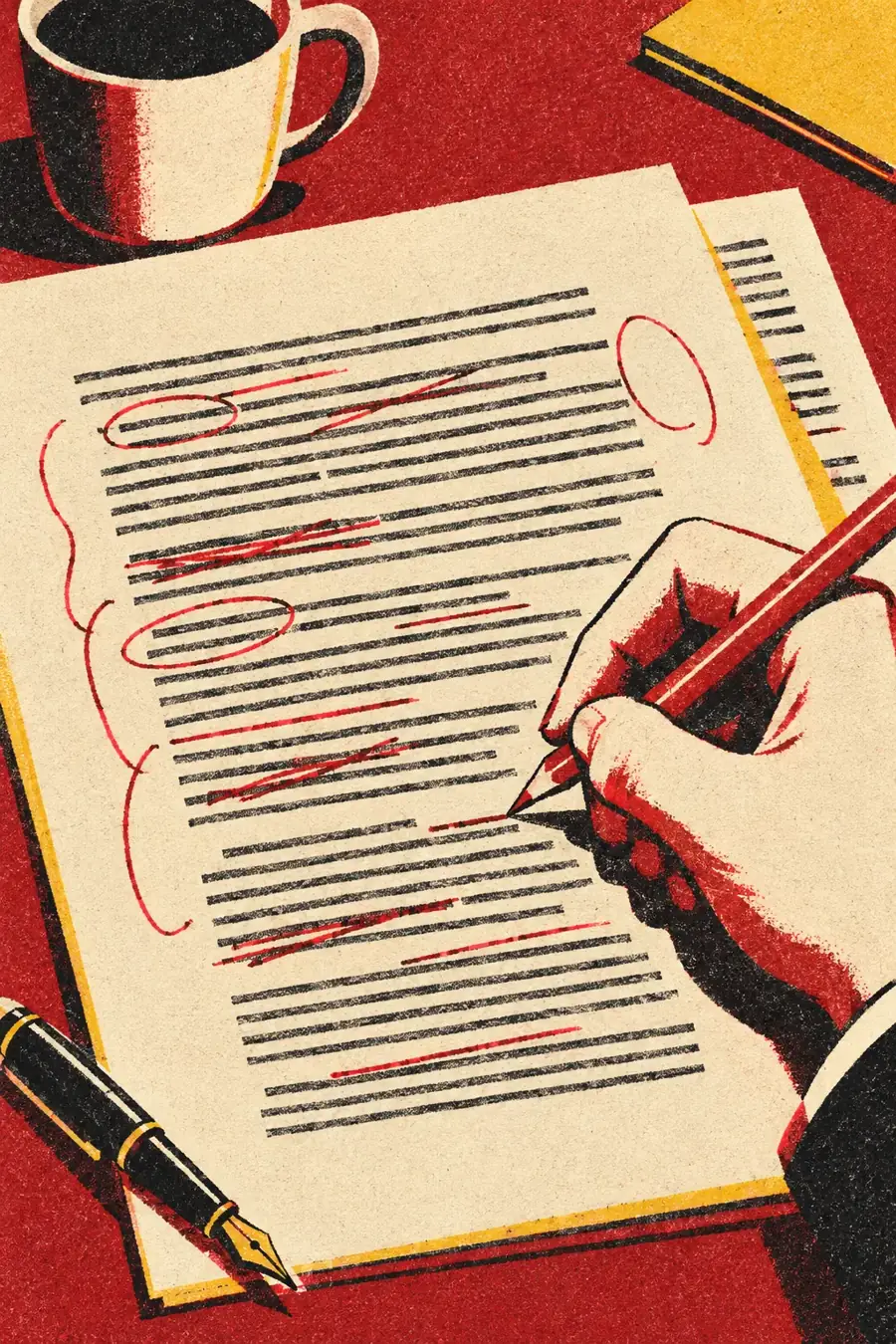
Trying to fix everything at once fixes nothing. Each pass has one question. Do them in order; later passes are wasted on paragraphs the earlier ones will cut.
Print it or zoom out. Write one phrase in the margin for what each paragraph does. Does the order make sense? Is anything repeated? Is the one-sentence version still true? Move whole blocks. Cut the paragraph you love that doesn't serve the sentence.
Where are you asserting something you haven't shown? Where is the strongest counter-argument, and have you given it a fair hearing? Mark every claim that needs a source or an example and go get one.
Does each paragraph start with its most important sentence or earn a delayed one? Do transitions move the reader or just fill space? Can any two paragraphs become one?
Read aloud. Cut adverbs, intensifiers, and throat-clearing. Replace "there is" and "it is" constructions. Convert passive to active unless the actor truly doesn't matter. Break anything over forty words or make it earn the length.
Every "very," "thing," "aspect," "utilize," "impactful." Every word you used twice in a paragraph. Every cliché. Every place a specific noun would beat a general one.
Leave it overnight if you can, an hour if you can't. Read it as the editor will, on a phone, with other things to do. Fix what makes you wince. Then file.
Tool
Paste a draft for a sentence-pass readout: rhythm, adverb load, likely passives, filler phrases. Everything runs in your browser; nothing is uploaded or stored.
Research & interviewing
A 1,500-word piece should rest on five to ten times that much material: interviews, documents, observation. Authority on the page comes from what you left out, not what you put in.
Write out your questions in advance so you know what you need. Then have a conversation. The best material comes from follow-ups: "What do you mean by that?" "What happened next?" "Can you give me an example?" Return to the list only to check you've covered the ground.
"What did the room look like?" "What were you holding?" "What did you say to him?" Sources give you summaries by default. Scenes are what make a piece readable, and you only get them by asking.
Silence after an answer is the most productive interviewing technique there is. Count to five. People fill silence with the thing they weren't going to say.
Ask permission to record. Take notes on what strikes you in the moment, with a timestamp, so you can find it later. Transcribe the parts you'll quote and check them against the audio.
Names, titles, dates, numbers, spellings. Every quote you weren't present for. Every statistic back to its original source. A single correction costs more trust than a dozen good pieces earn.
On the record means everything is usable with attribution. On background means usable without naming the source, by an agreed description. Off the record means you cannot use it at all. Agree in advance; never retroactively.
Forms
| Form | Length | The job | The usual failure |
|---|---|---|---|
| Reported feature | 1,500 to 5,000 words | Make the reader understand a person, place, or phenomenon through scene and evidence. | All information, no narrative; or all narrative, no point. |
| Personal essay | 800 to 3,000 | Use one specific experience to reach something a stranger recognizes. | Confession without reflection. The piece ends where the thinking should begin. |
| Op-ed / argument | 600 to 900 | Make one claim, support it, address the strongest objection, say what should happen. | Three claims, no evidence, no objection, ends with "we must do better." |
| Explainer | 800 to 2,000 | Take a confusing subject and leave the reader able to explain it to someone else. | Explaining what the writer found interesting instead of what the reader needs. |
| Profile | 1,200 to 4,000 | Show who someone is through what they do, say, and what others say about them. | Hagiography. No tension, no second source, no moment the subject is less than impressive. |
| Q&A | 800 to 2,500 | Let a knowledgeable person talk, edited for clarity and shape. | Published in the order asked. A Q&A should be restructured like any other piece. |
| Brand article / content | 800 to 2,000 | Genuinely help the reader with a problem adjacent to what the client sells. | Selling in paragraph two. Readers leave, and the client's goal fails with them. |
| Case study | 600 to 1,500 | Problem, approach, measurable result, in the customer's words where possible. | No numbers, no obstacle, a quote that reads like it was written by marketing. |
| White paper | 2,500 to 6,000 | Make an authoritative, sourced argument that a decision-maker can act on. | A long brochure with footnotes. |
| Book proposal | 30 to 60 pages | Convince an editor the book is necessary, you are the one to write it, and people will buy it. | A great overview and a weak marketing section. Publishers read the marketing section first. |
Reading list
In the order we'd read them. Most are available at any public library.
The clearest case ever made for clarity. Read the chapter on clutter once a year.
Ninety pages. Disagree with some of it; absorb all of it.
On structure, from the writer who thinks about it harder than anyone. The essay on structure alone is worth the price.
Fifty-five concrete, practical strategies. The book to keep open while revising.
A reset for writers who have learned to write the way school taught. Slow, strange, and clarifying.
On the emotional life of writing: shitty first drafts, short assignments, and how to keep going.
Half memoir, half toolbox. Blunt, generous, and right about adverbs.
For anyone writing from life. On truth, voice, and the ethics of writing about people who didn't ask to be written about.
Fifty-plus working nonfiction writers on reporting, structure, ethics, and the business. The best single anthology on narrative journalism.
Not a craft book; the house style of most American newsrooms. Know it so your copy arrives clean.
Practice
One a week. Each takes under an hour. Practice on your own material, not on hypotheticals.
Week 1
Take a published piece of yours, 1,000 words or more, and cut it to half its length without losing a fact. Notice what went.
Week 2
Write five completely different openings for the same story: a scene, a fact, a quote, a question, a single short sentence. Pick one. Know why.
Week 3
Print a long piece by a writer you admire. In the margin, write one phrase for what each paragraph does. Study the shape.
Week 4
Describe a room, a person, and an event in 300 words using no adjectives or adverbs. Nouns and verbs only.
Week 5
Take an opinion you hold and write the strongest 400-word case against it, as its best advocate would. Then revise your own position.
Week 6
Fifteen minutes with someone you don't know about their work. Get one scene and one surprising fact. Write 300 words.
Week 7
Write one sentence of five words, then ten, then twenty, then forty, all on one subject, each grammatically clean. Then reverse it.
Week 8
Record yourself reading a draft. Listen the next day. Mark every place you stumbled or sped up. Those are the sentences to fix.